Showing posts with label languages. Show all posts

Thursday, July 14, 2016

Amharic

Addis Ababa; WikiCommons
Amharic is one of the semitic languages of Ethiopia, and is currently the second most spoken semitic language in the world (Arabic is #1).  Over 20 million people speak Amharic, and it currently serves as the official language of Ethiopia.

We don't have any ancient writings in Amharic, with our earliest extant Amharic texts possibly coming out of the 14th century.  So in a sense it might be an odd language to feature on this blog.  Nevertheless, there are several good reasons to learn some Amharic:


  • It's a fascinating and beautiful language spoken by over 20 million people.
  • As a Semitic language it is relevant for those with an interest in comparative semitics.  
  • It is relevant for those who work with Ge'ez, as we can identify Amharic influences on the Ge'ez language and literature.
  • For those, like myself, who have interest in the history of scriptural interpretation in the Ethiopian tradition, Amharic is significant as the language of the andemta commentaries.
  • It's way more interesting than learning French.

Unfortunately it is not easy to find courses in Amharic.  CARLA lists the following institutions that offer Amharic in North America: Foreign Service Institute, Harvard U, Michigan State U, U of Florida, Boston U, National Foreign Affairs Training Center, Stanford U, U of Kansas, U of Pennsylvania, New School University, and World Mentoring Academy.

As far as scholarship goes, there is a plethora of resources on Amharic.  Here I just offer a few resources that might be helpful:

Ethnologue entry.

OLAC Resources in and about the Amharic Language.

Selected Annotated Bibliography on Amharic from Grover Hudson (MSU).

Isenberg, Charles William.  Dictionary of the Amharic Language. [downloadable]

Amharic course from the Foreign Service Institute.   [follow the link to Indiana University for the remaining audio files.  The audio files can be found a few other places on the web too].

Appleyard, David. Colloquial Amharic. [the audio files can be downloaded for free]

Amharic at Deutsche Welle.

National Bibliography of Ethiopia.

Meyer, Ronny.  "Amharic."  Pages 1178-1211 in The Semitic Languages: An International Handbook.  Edited by Stegan Weninger et al.

Writing the Amharic Script.

Sunday, May 15, 2016

1 Enoch Reading Guide (15:1-16:4)

I've posted another Ethiopic reading guide, this time for 1 Enoch 15:1-16:4, a particularly interesting portion of the Book of the Watchers.  Enoch and other Second Temple Jewish texts are of course worthy subjects of study in their own right, but this particular text might be especially relevant for understanding some bits of the New Testament, for example offering a possible answer to the question "who in the world are those demons and why do they keep trying to possess human bodies?" or providing some background for Luke's version of Jesus' response to the Sadducees (Luke 20:34-36).

You can download the reading guide here.


Or if you're not too interested in Ge'ez and want to take a peek at an English translation, you can go here.

Saturday, August 15, 2015

Ethiopic Enoch Reading Guide: Chapters 1-5

I've put together and posted another Ethiopic reading guide, this one for the first five chapters of 1 Enoch.  The first six pages include a transcription of Charles' Ethiopic text with plenty of space between lines and a large margin for taking notes.  The remaining pages have an alphabetical vocabulary list with English glosses, a list of verses where the words occur in these chapters, and a page number for the entry in Leslau's concise lexicon.

1 Enoch 1-5 is an interesting unit of the text that serves as an introduction to the Book of the Watchers and the corpus as a whole.  Lots of theophany language -- if you've ever wanted to know how to talk about mountains melting and shaking in Ge'ez, this is the text for you.

You can download the reading guide here.

You can also download two other Ethiopic reading guides for the Book of Jubilees on my Academia.edu page.

Happy translating!

Wednesday, August 5, 2015

Gird up the Loins of your Mind

English translations of ancient texts often conceal interesting expressions in the original languages.  A nice example of this is I encountered recently is 1 Peter 1:13.  In the NIV we read:

"Therefore, with minds that are alert and fully sober, set your hope on the grace to be brought to you when Jesus Christ is revealed at his coming."

The NRSV renders it:

"Therefore prepare your minds for action; discipline yourselves; set all your hope on the grace that Jesus Christ will bring you when he is revealed."

The Greek phrase behind "with minds that are alert" or "prepare your minds for action" is: anazōsamenoi tas osphuas tēs dianoias humōn.  We could more literally translate this as "girding up the loins/waist of your mind."

The "girding of loins" might be familiar to some Bible readers.  We see it as part of the Passover instructions (Exodus 12:11), it is something Elijah does before running (1 Kings 18:46), and God tells Job to "gird up now thy loins like a man" in the little heart to heart they have at the end of the book (Job 38:3; 40:7).  Other examples: 2 Kings 4:29; 2 Kings 9:1; Jeremiah 1:17; Luke 12:35; Ephesians 6:14 (and this is only some of the "girding" that happens in the Bible).

The general idea is that when you're wearing flowing clothing that covers your legs, like different kinds of skirts or robes, it can be hard to run or engage in other movements (which is why Elijah does it before running).  So, tying your clothing up around your waist area frees up your movement.  This Huffington Post article features some visuals of what this process might look like.  

Peter is using this image metaphorically: gird up the loins of your mind.  The sense is probably to prepare one's mind, perhaps, as the NRSV suggests, for some kind of action.  Or, it may just communicate, as the NIV suggests, a level of alertness.  It's an interesting image, and one which we would entirely miss if we only relied on some of these translations!  A few English translations have brought the phrase out in different ways.  The KJV rendered it literally:

"Wherefore gird up the loins of your mind, be sober, and hope to the end for the grace that is to be brought unto you at the revelation of Jesus Christ."

The Message, which is a radical paraphrase, offers this:

"So roll up your sleeves, put your mind in gear, be totally ready to receive the gift that's coming when Jesus arrives."

I particularly like what the Message does, because it translates the language into an image that makes more sense to many of us in English.  This example serves as a good reminder to use as many different translations as you can, and another good reason to learn the original language of ancient texts you like to read!

Something I am left curious about is questions of gender and this expression.  Is "girding up one's loins" masculine?  A lot of interpreters explain the phrase as meaning "man up" (check out the use in Job).  Would this have been a masculine image for Peter?  Would ancient women also have had the experience of needing to tie up some forms of clothing to increase mobility? (See line 286 of Atrahasis).

Wednesday, February 5, 2014

Ethiopic Jubilees Reading Guide: 11:1-10/The Rise of Civilization

Reading Guide
I've been working on a project involving Ethiopic Jubilees and thought I'd make a little of the data available for those who are learning Ge'ez.  I've put together a little reading guide for Jub. 11:1-10, that exciting bit of the book that talks about the beginnings of civilization after the flood.  It turns out that it didn't take long for humans to start killing, enslaving, and oppressing each other.  The reading guide has a list of all of the Ge'ez vocabulary for this section, as well as English glosses and the page reference for the appropriate entry in Leslau's concise lexicon.  I also included a few bullet points that point you to parts of Lambdin or Leslau that will help in translating the text.

You can access the reading guide here.

Happy translating!


Tuesday, December 31, 2013

iTunes U: Courses in Classics and Biblical Studies

Every time class registration rolled around I would pore over the course listings for the many different departments at the university, wishing I had an endless amount of electives I could take.  Now with things like iTunes U I can sit in on lectures in some of those classes outside of my major that I just wasn't able to fit into my degree program, whether its psychology, history, or physics.  This interdisciplinary online buffet also includes some good resources in my areas of focus, the ancient world and religious studies.  Below are a few that you might want to check out.  I've broken them down into four categories: (1) Biblical Studies, (2) Ancient Greece, (3) Rome, and (4) Religious Studies.  When you're done with all of these, why not move on to learn about Quantum Mechanics?

Biblical Studies
Christine Hayes
Open Yale course
[Check out Hayes' openyalecourses book Introduction to the Bible)

Shaye J.D. Cohen
Harvard, iTunes U

Dale B. Martin
Open Yale course 
[Check out Martin's openyalecourses book New Testament History and Literature)

Stanford, iTunes U

Steven Schweitzer
AMBS, iTunes U

Daniel B. Wallace
The Center for the Study of New Testament Manuscripts, iTunes U


Ancient Greece
Gillian Shepherd
LaTrobe, iTunes U

Gillian Shepherd
LaTrobe, iTunes U

Monday, December 30, 2013

Ancient Handwriting

Medical doctors are not the only ones with bad handwriting.
If you've studied any languages that use a non-roman script, then you may have had your own handwriting let-downs.  You look at the perfectly printed letters in a critical edition or the breathtaking artistry of a scribe in a particularly nice manuscript, and then you go to scribble down a line or two of your own and it looks like -- well, scribbles.

What if we saw learning to write well as part of the process of acquiring an ancient language?  What if we saw it as a way of more fully appreciating the language and perhaps gaining a better understanding of the ancient scribes who copied all of this wonderful stuff for us?

If this is something that interests you, then you might check out The World Encyclopedia of Calligraphy: the Ultimate Compendium on the Art of Fine Writing.  It is an attractive volume with lots of colour photographs.  It offers some introductory information on the art of calligraphy before going into detail on some of the world's most interesting calligraphic traditions.  These include: Roman scripts, Cyrilic, Arabic, Indic scripts, Tibetan, Chinese, Japanese, and Korean.  For those who study classics and the Judeo-Christian traditions you might be particularly interested in the sections on: Greek, Ashkenazi Hebrew, Sephardi Hebrew, Dead Sea Scroll Hebrew, Syriac, Georgian, and Armenian.  I picked up the book in a public library in order to learn how to write Ge'ez better.  It does have a section on Ethiopic, although it is quite short (2 pages).  I did learn, however, that to write good Ge'ez your pen angle needs to be anywhere from perfectly flat to 10 degrees, a helpful little tip.

If you come across other resources that might be helpful for those wishing to improve their writing of ancient or medieval scripts, please post them in the comment section below!  Learn World Calligraphy is a title that come up in my searches, but I have not gotten my hands on it yet.

Monday, October 21, 2013

Glottolog: A Great Source for Ancient Language Bibliography

A friend recently brought Glottolog.org to my attention.  It is a world language reference website that includes some really helpful bibliographies.  Each language is assigned a unique "glottocode" and is organized according to its language family.  The entries for each glottocode include bibliographies for that language.  A few that might be particularly interesting to you:

geez1241 (Ge'ez)

lati1261 (Latin)

anci1242 (Greek)

anci1244 (Ancient Hebrew)

sama1313 (Samaritan)

ugar1238 (Ugaritic)

aram1259 (Aramaic; with further sub-categories of Eastern Aramaic, Western Aramaic, and Old Aramaic, and those sub-categories are broken down even further into categories like Mandaic)

clas1252 (Classical Syriac)

Wednesday, August 28, 2013

Greek Pictionary

"Jackal . . . it's a jackal!"
One of the students in the Greek class I teach at my church recently suggested we try something new: playing Greek Pictionary.  This sounded like much more fun than a boring vocabulary quiz, so we gave it a try.  We focused on reviewing the vocabulary from four earlier chapters in our textbook.  I would write down a word (in Greek) from one of those four chapters, then pass it off to a volunteer who would try to get the rest of the group to guess the word by drawing on a dry-erase board.  To properly guess the word it needed to be written down in Greek (guessing the English definition was not enough).  It was fun!  Some thoughts if you test it out in your own ancient language classes:

  • If you're unfamiliar with the rules of Pictionary, check out good old Wikipedia: http://en.wikipedia.org/wiki/Pictionary
  • Open book vs. closed book?  We did it open book, but if you wanted to make it more challenging, you could do it closed book.
  • Competitive or collaborative?  You could have the whole group working together to figure out the word, or you could break up into teams.
  • When people play Pictionary there are a lot of different strategies to get your team to guess the word.  For instance, if your word is "wellness" you might try to draw something that communicates the meaning of the word, like someone looking healthy.  Alternatively, you might draw some pictures that will get your team to guess the individual sounds that make up the word, a "sounds like" strategy.  So you might draw a picture of a water well to get them to say 'well' and then a picture of the Loch Ness monster to get them to say 'ness.'  If you want to crank up the difficulty level (maybe for a second year readings class?) you might prohibit your students from using any English words if they use a "sounds like" strategy.  If they want to do use this strategy they have to use Greek words.  So in the example I gave, they could not draw a water well to get someone to say the sound "well."  But they could draw a water well to get someone to say "phrear" (which is probably not going to help them at all).       
If you try it out, let me know how it goes!

After we played I did a little Internet search, and it looks like some homeschoolers are already finding this (and charades!) a fun way to learn Greek vocab.   

Thursday, August 15, 2013

Greek

My Big Fat Greek resource page (ok, as far as resource pages go it is fairly slender right now.  But we'll get there).

Greek is a wonderful language that began in the ancient world and continues to be spoken today.  For the student of the ancient Mediterranean world Greek is possibly the most important language to learn.  It's the language of Homer, Hesiod, Herodotus, Plato, Euripides, the Septuagint, the New Testament, and many of the early Christian writers.  Because of Alexander the Great's conquests Greek became the lingua franca of the ancient Mediterranean world in the late 4th century BCE, and continued to be widely used into Roman times.

Whenever languages are around a long time they go through stages of development (think about Chaucer vs. Shakespeare vs. Stephen King), and Greek is no different.  In addition to historical developments, different dialects of a language can exist simultaneously.  This all means you have different choices when you decide to learn the language: Homeric Greek, Attic Greek, Koine (or "Biblical") Greek, Byzantine Greek, or Modern Greek.  If you want to be a real nerd you can even learn Linear B/Mycenaean Greek, which will allow you to read riveting inscriptions with lists of goods and possessions (you accountants/ancient language aficionados might enjoy this).

Saturday, August 10, 2013

AMQ: Star Wars in Ge'ez #2

For our last Ancient Movie Quotes (AMQ) we translated Luke's line to Obi-Wan in Star Wars: Return of the Jedi ("You told me Vader betrayed and murdered my father!") into Ge'ez.  This time we will translate some of old Ben's response.  If this Ge'ez stuff intrigues you, be sure to cruise the resource page.

"Your father was seduced by the dark side of the Force."

ተአብደ ፡ አቡከ ፡ በክፍል ፡ ጸሊም ፡ ዘነፋስ ፡ ሕያው ።
(ta'abda 'abuka bakefl ṣallim zanafās ḥeyāw)

We started our translation with the passive form of the verb አብደ ('abda; "was seduced").  The ተ- (ta-) prefix is a marker for the passive verb.  We then have the subject አቡከ ('abuka; "your father").  Recall that passive verbs are ones in which the subject of the verb is acted upon -- something is happening to the subject.  With passive verbs we can talk about things like agents, means, and instruments: who is the agent doing this thing to the subject or who/what is being used to do this thing?

Thursday, August 1, 2013

AMQ: Star Wars in Ge'ez #1

One of the exercises we did in the Greek class I teach is translate famous movie quotes into Greek.  It's a fun way to play around with the language and explore the different ways you can say the same thing. I thought I'd start offering some of my own fiddlings around with ancient movie quotes (AMQ) here.  Please let me know if you think there are better ways to make these translations!

Star Wars in Ge'ez #1

In episode IV (A New Hope) Ben (Obi-Wan) Kenobi tells Luke about his father, bragging about what a great Jedi, pilot, and friend he was, before telling Luke that a young Jedi named Darth Vader betrayed and murdered him.  We later learn (along with Luke) that this was only true "from a certain point of view."  When Luke confronts the spirit of Obi-Wan on Dagobah he complains: "You told me Vader betrayed and murdered my father!"  Here's our Ge'ez rendering:

ነገርከኒ ከመ አግብአ ወቀተለ ወድር አባየ  
(nagarkani kama 'agbe'a waqatala wader 'abāya)

So let's break this down a bit.  First we have a perfect verb in the 2nd masculine singular (ነገርከ/nagarka) to which we've attached a 1st person singular object suffix (ኒ/ni).  We've packed "You told me . . ." into one handy little word.  We've then used the conjunction (ከመ/kama) to introduce the indirect speech (Dillman, 538).  For the verb "betray" we had a few different options, since Leslau lists three different verbs with this meaning: ከድዐ, (አ)ግብአ and ጠለመ.  I went with the second one just because that's the word used for Judas' betrayal in passages like Mark 3:19 and 14:10.  Then we have our conjunction ወ/wa and our second verb (ቀተለ/qatala) in the perfect 3rd person masculine singular.  I chose to use verb-subject-object word order, so we have Vader (ወድር/wader) followed by the accusative form of "father" with the 1st person singular pronominal suffix (See Lambdin, 41 where we learn that አብ looks like አቡ- /'abu- when it takes a pronominal suffix, unless it is in the accusative in which case it looks like አባ- /'abā-).

Some things I was curious about:
  • What is the typical word order (if any) when you have two verbs (betray, kill) that share the same direct object (my father) and a stated subject (Vader)?
  • If we wanted to use a qatalo lanegus instead of the simple accusative, what would that look like?  Would it be as simple as putting the 3ms suffix on both verbs followed by ለ-?
Would you translate this any differently?  And more importantly, was Luke right to be a little peeved with Obi-Wan?

Friday, July 26, 2013

Dead Language Bonanza: The Cambridge Encyclopedia of the World's Ancient Languages

All humans ask many of the same big, important, and often unanswerable questions about life: Where did we come from? What is the meaning of life, the universe, and everything?  And where can I find a basic grammatical description of nearly every ancient language I could imagine in one volume?

The answer to the ultimate question is of course 42 and the answer to the final and arguably more important question is The Cambridge Encyclopedia of the World's Ancient Languages.   Roger Woodard's mammoth volume brings together a small army of scholars who have contributed 20-30ish page grammatical overviews for many of our world's ancient languages.  Just to give you a taste of the breadth of the volume, here is what it covers:


Sumerian
Elamite
Hurrian
Urartian
Afro-Asiatic
Ancient Egyptian and Coptic
Akkadian and Eblaite
Ugaritic
Hebrew
Phoenician and Punic
Canaanite dialects
Aramaic
Ge'ez (Aksum)
Ancient South Arabian
Ancient North Arabian
Indo-European
Hittite
Luvian
Palaic
Lycian
Lydian
Carian
Attic Greek
Greek dialects
Sanskrit
Middle Indic
Old Persian
Avestan
Pahlavi
Phrygian
Latin
Sabellian languages
Venetic
Continental Celtic
Gothic
Ancient Nordic
Classical Armenian
Etruscan
Early Georgian
Ancient Chinese
Old Tamil
Mayan
Epi-Olmec

Be honest, did you even know that all of these languages existed?

Monday, July 22, 2013

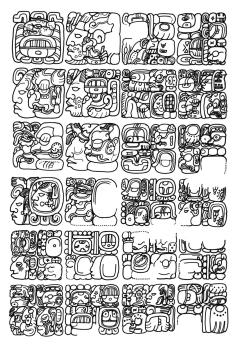
Maya "Hieroglyphs"

Clearly they were wrong about the end of the world, but maybe the ancient Maya have something else useful to teach us?
From the Linda Schele Drawing Collection

Most of my personal study focuses on the ancient Mediterranean world, so ancient Mesoamerican civilizations and their languages are about half a world outside of my academic comfort zone.  But in anticipation of my upcoming visit to the Ancient Maya exhibit at the Science Museum of Minnesota, I thought I'd add at least a rudimentary post on ancient Maya "hieroglyphics" to our ancient language resource page.  If you are interested in Mesoamerican civilizations you might want to check out some of these resources, and maybe try your hand at learning some of the Maya "hieroglyphs" (it is a logosyllabic script, popularly called hieroglyphic because it reminds us of Egyptian).   If, like me, your ancient gaze lies elsewhere, it is still a fruitful exercise to learn something about the language.  For one thing, its hundreds of symbols will make any challenges you encounter with ancient alphabet or even abugida scripts seem less daunting.  But there is also value in the comparative study of ancient languages, writing systems, and cultures.  What comparative light might the Mayans shed on your own areas of research?

Saturday, July 13, 2013

Ge'ez (Classical Ethiopic)

Ge'ezundheit!
Ge'ez is the classical language of Ethiopia.  As a member of the Semitic language family its relatives include familiar languages like Hebrew and Arabic.  Ge'ez is really important for students of Greco-Roman Judaism and the history of Christianity.  The Christianization of Ethiopia (4th century CE) led to the translation of Jewish/Christian writings into Ge'ez, including important Jewish writings like 1 Enoch and Jubilees.  We have since lost most of the earlier Greek and Hebrew/Aramaic versions of these Jewish texts, so they only exist today in their entirety in Ge'ez translation. This makes it an important language for students of early Judaism.  Beyond these Jewish writings the Ethiopian manuscript tradition contains many Christian works translated from Greek and Arabic, and also includes indigenous Ethiopian Christian resources -- most of which have not been translated into English.  For those interested in studying non-western Christian history, learning the Ge'ez language will be very rewarding.

Thursday, July 11, 2013

Syriac

They say that learning obscure old languages like Syriac is fairly impractical for day-to-day life.  In most cases they're probably right.  However, when I was working as a heating/cooling salesman, I did once have an opportunity to use Syriac in my job.  I was giving an estimate on some ductwork in the home of an Assyrian Christian, who happened to have a Syriac prayer on his wall (which he could not read).  My Syriac had gotten very rusty (much like his ductwork), but I was still able to read some bits of it to him.  I'd like to think my shaky knowledge of Syriac is what got me the sale!  So yes, there is money to be made in these obscure languages.