Showing posts with label ancient scholarship.. Show all posts

Monday, April 20, 2015

Scripture in the Mishnah

An excellent resource for those interested in early Jewish interpretation of scripture is Alexander Samely's Midrashic Units in the Mishnah.  The website is a companion to his fascinating work Rabbinic Interpretation of Scripture in the Mishnah (Oxford: Oxford University Press, 2002).  Find it in a library here, or purchase it here. 
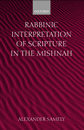
The website has a database and accompanying resources for all of the examples of biblical interpretation in the Mishnah with the exception of Avot (which the author indicates will be added in the future).  Samely has provided an English translation of each Midrashic unit and an analysis/commentary that uses the categories and terms he developed in his book.

You can search by tractate, biblical book, the code/category, the rabbi, formal features, or use a search term field.

This is a fantastic online resource for those interested in early scriptural interpretation and Rabbinic literature.  

A good summary quote from chapter 2 of Samely's book:

"Mishnaic interpretations do not target the whole of Scripture, or any one of its larger parts, but rather segments approximately of sentence length.  The hermeneutic licence to cut the text into small units which can be interpreted as if they stood alone creates a wide hermeneutic choice.  Its fundamental effect is that the segment, taken in isolation, is less determined in topic, reference, or meaning than as part of a Scriptural environment (co-text).  The Mishnah, in surrounding the segment with different co-text, can thus appoint a fresh topic, reference, or meaning for the biblical words" (31).

Tuesday, August 27, 2013

Ancient Aliens, Christian Apologetics, and the Narrative of Ancient Anachronism

This is a brief description of a little research project that's on my docket once my thesis is finished.  If you come across any examples of the narrative of ancient anachronism, I'd be much obliged if you sent them my way.  I became interested in analyzing the ancient astronaut theory when I did a search on Google+ for communities dedicated to the study of the ancient world.  I was shocked and a little dismayed when my search for "ancient" turned up a group on ancient aliens that had over 2,000 members, while the next largest group (Ancient Greek Philosophy) had only 200.  This got me thinking that while the ancient alien stuff may seem far out there, it has become one of the primary ways that ordinary people are exploring the ancient world.  I think that invites interaction with and critique of the movement by those who spend their days studying the ancient world in an academic setting.    

"In recent years the ancient astronaut theory has gained a lot of interest and support in popular culture, thanks in large part to the History Channel's "Ancient Aliens" series.  This theory claims that extra-terrestrial beings visited earth in ancient times, and that we can find evidence of their visit in ancient religion, mythology, and architecture.  The theory is built on assumptions about the primitive nature of ancient peoples and thus their inability to carry out many of the building feats of the ancient past.  Because they were too primitive to construct such things, a higher, more advanced race must be responsible for them.  Interestingly, this is not the only example of this narrative being employed in discussions of the ancient world.  Some Christians have used this narrative in their apologetic interpretations of the Bible.  They assume not only the technological and scientific inferiority of ancient peoples, but their moral inferiority as well.  They then attempt to identify examples of comparatively more scientifically and morally advanced concepts in the Bible.  While proponents of the ancient astronaut theory explain the supposed architectural anachronisms they identify with recourse to extra-terrestrials, Christian apologists see the scientific and moral anachronisms they find in the Bible as the result of divine intervention.  In this study we will explore this narrative of ancient anachronism, comparing the ways that it has been used both by proponents of the ancient astronaut theory and by Christian apologists.  In both cases we find groups creating a false anachronism in the ancient world and then offering an explanation for this anachronism that involves extra-human intervention.  In both cases the false anachronism is based on more basic assumptions about the primitive nature of ancient peoples."

Tuesday, July 30, 2013

Ancient history, scholarly objectivity, and Reza Aslan


If some people have their way any Muslim scholars at this year’s Society of Biblical Literature meeting will need to wear an “I am a Muslim” name tag before they can contribute.


I never thought I’d be interacting with Fox News on my ancient studies blog.  I am sure that many of you have already seen the Fox News interview with Reza Aslan about his new book, Zealot.  And I am sure many of you also found it difficult and frustrating to watch.  Lauren Green, taking a cue from John Dickerson’s equally troubling Op-Ed, focuses on Aslan’s identity as a Muslim, questioning why a Muslim would want to write about Jesus and accusing him of concealing his Muslim identity while he peddles anti-Christian views of Jesus in the guise of scholarship. 

I have not yet read Zealot, so I cannot comment on its contents.  But the Fox News interview and Op-Ed raise some important questions about popular perceptions of ancient historical scholarship and the nature of objectivity.  Here are some things that Lauren Green, John Dickerson, and the general public should know:

Wednesday, July 17, 2013

Scholarship on Scholarship: Eleanor Dickey's "Ancient Greek Scholarship"

Scholia and Eustathius . . . I think my doctor diagnosed me with that once.

Believe it or not, modern classicists are not the first nerds scholars to analyze and write about Greek "classics."  Even 2,000 years ago there were precocious young adults adding gray hairs to their parents' heads: "Mom, Dad, I have something to tell you -- I've dropped out of my business program and decided to major in classics."  Ancient works like Homer, Hesiod, or Euripides were carefully preserved and studied by ancient and medieval scholars, many of whom asked the very same sorts of questions we like to ask today.